Maria Leonard Olsen On 5 Things They Forgot To Mention In College
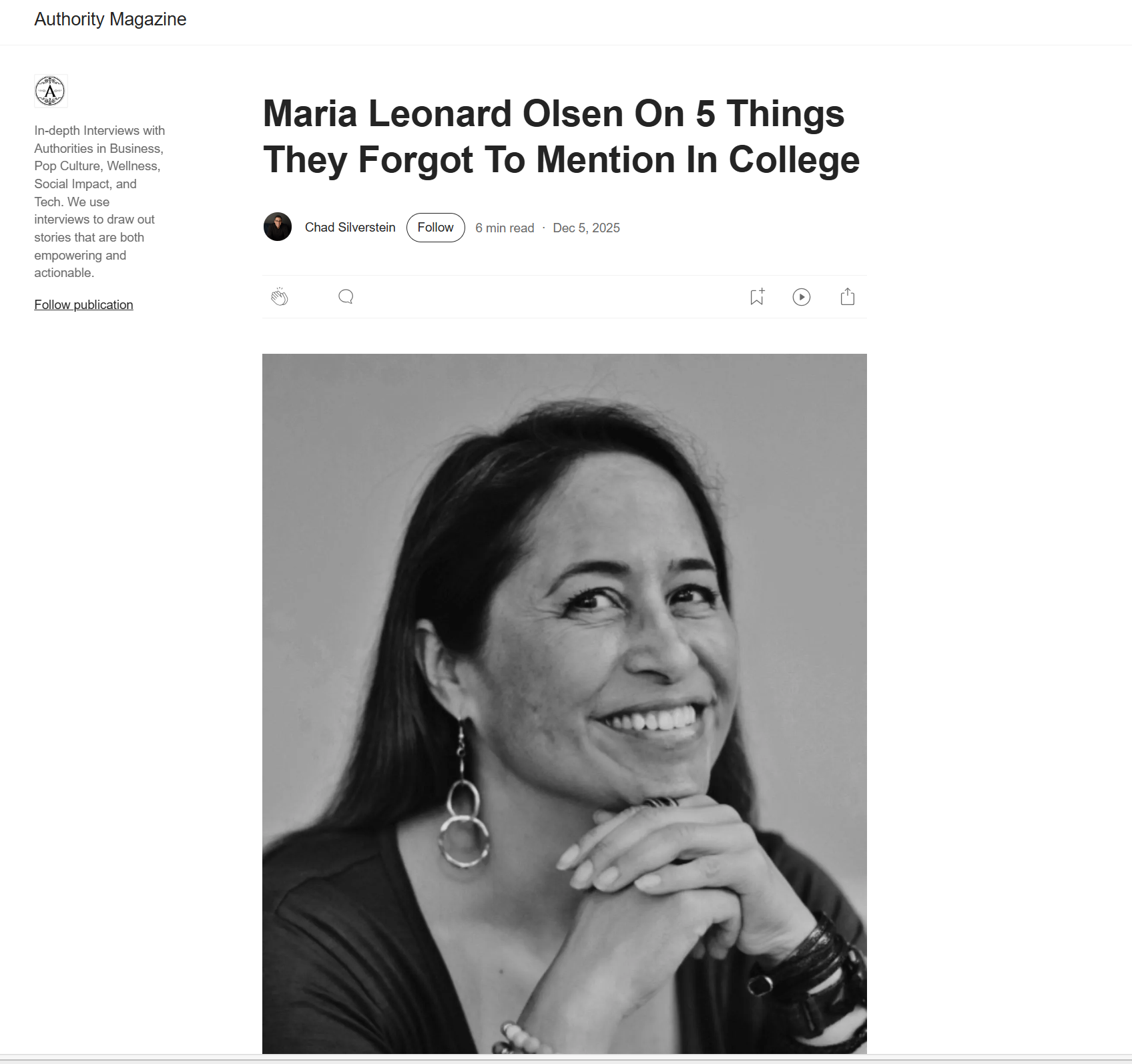
Maria Leonard Olsen practices law as a commercial litigator in Washington, DC. She is an author (50 After 50: Reframing the Next Chapter of Your Life), podcaster (“Becoming Your Best Version”), journalist, TEDx speaker (“Turning Life’s Challenges into a Force for Good”), book marketing coach for female authors and mentor to women in recovery. Learn more at MariaLeonardOlsen.com and follow her on social media @FiftyAfter50.
Thanks for being part of this series. Let’s jump in and focus on your early years. Can you share who was your biggest influence when you were young and provide specific examples of what you learned from them that helped shape who you’ve become and how you live your life today.
When I was a young attorney, a female attorney took time to teach me how to be an effective lawyer. She carefully edited my writing and encouraged me to be the best legal advocate. She taught me how to be unapologetic in my power, to navigate a profession dominated by men in the 1980s, to act professionally and courteously, to balance family with work and never to lose my sense of humor. The time she took with me to show me how I could improve my writing, for example, helped me become more concise in my writing and taught me to help those coming up in the ranks, as well. I continue to help those who are earlier in their career path, knowing how much it helped me. In other words, I pay it forward every day.
Staying on the topic of influence, who has been your biggest catalyst more recently and what can you share that you’ve learned from them that led you to making changes in your life?
I got sober when I was 50 years old, after blowing up my marriage with my drinking. My sponsor in Alcoholics Anonymous loved me until I could love myself again. She taught me how to help other women who are struggling with substance abuse. She taught me that I can live my amends to those I have hurt and how to have a fulfilling life without alcohol. I am proud of all the people I have helped by sharing my experience, strength and hope.
In this interview series, we aim to reveal what seasoned entrepreneurs wish they had known when they were starting out and capture what the textbooks and college professors left out.
Mistakes are invaluable. Can you name one specific mistake that you made early on, and learned the most from, but wish you’d been forewarned about?
I majored in computer science because I had no idea what I wanted to do at age 18 and my mother wanted me to follow the path she had taken. I had very little interest in that field, however. I wish I had been encouraged to follow and develop my interests. I likely would have become a journalist. I wish I had been forewarned that most career paths are not linear and that we can pivot whenever we want.
Is there a leadership myth you believed early on that you’ve since debunked through your real-world experience?
One leadership myth was that one should not show any weakness. I think that has changed today. People appreciate authenticity, even from their leaders. Everyone needs help from time to time. Teamwork is stressed more now.
What’s the key operational insight you’ve gained since running your business that was never mentioned in any classroom.
One operational insight is the importance of outsourcing what cannot be handled efficiently in-house. It is ok to reevaluated decisions when necessary and beneficial. Just because something has been done a particular way for a long time does not mean it is the most cost-efficient or best use of employees’ time.
Did college prepare you for scaling a business? What specifically was missing?
I think college is more big-picture, versus nuts and bolts. When I was in school, there was no course in finding funding or investors, for instance. Perhaps that has changed. Also, the importance of mentors and collaboration was not touched upon and both are so beneficial.
Any unexpected challenges in team dynamics that your academic experience didn’t prepare you for? How did you handle it?
No one teaches you in school how to leave a job gracefully, or how to fire subordinate employees. Instruction in both would be helpful.
Have you had to unlearn any widely-accepted business ‘wisdom’ in your journey? What was it and how did it affect your strategy?
In the 1980s, women were taught that they could have it all. More accurately, we can have it all but maybe not at the same time. It is important to prioritize and to seek appropriate help, including mental health care when needed. I suffered from anxiety and could have benefitted from earlier assistance in that area. It is more acceptable now to seek mental health care. It is more widely accepted as an important form of self-care.
What’s your advice for new entrepreneurs? What are your “5 Things You Won’t Learn in College But Must Know to Succeed in Business”?
1. Many positions are filled by connections. Nurture your connections and do not burn any bridges. You cannot know what the future will hold or who might be in a position to help you one day.
2. Put the people you care about first. Others can do your job, but no one can be the particular family member or friend that you can be for another person. If you lose those you care about in the pursuit of professional success, you really will not have anything worthwhile in the end.
3. Strive for balance. You must practice self-care in order to succeed. If you only work, your life will be pretty dismal. And you cannot take wealth with you when your time is over, so prioritize things that matter to you aside from only work.
4. It is ok to pivot. If you do not love your life, try something different. Few people nowadays keep the same job for their entire working career.
5. Seek help when you need it. Obtaining help when needed is a sign of wisdom and strength, not weakness. I may not be the smartest person in the room, but I am resourceful and know where and how to seek help. And when you do receive help, express gratitude and pay it forward.
How do you ensure your team not just understands but embodies your business principles? Any techniques you wish you’d known earlier?
Check in with your team regularly. Ask for their input, so they feel valued and respected. Know about their families and exhibit true caring about your colleagues as people. Social events help provide opportunities for your team to know one another better and can decrease stress.
If we were sitting together two years from now, looking back at the past 24 months, what specifically has to happen for you personally and professionally, for you to be happy with your results?
I would be happy with a high employee retention rate, job satisfaction and recognition for a job well done.
Looking back over the last two years, what key accomplishments make you satisfied with your progress?
I am pleased that I will be doing my second TEDx Talk this October to share more about my experience to help others navigating challenges. I have another book contract. And my legal practice is thriving with happy clients for whom I have achieved strong results.
As someone with significant influence, what’s the one change you’d like to inspire that would benefit the most people?
I would like to see less hate in the world. We are only here for a short time, of uncertain duration. I wish we all could spend more time lifting each other up rather than hurting others.
How can our readers keep up with your work?
Check out my personal website, www.MariaLeonardOlsen.com, and professional website, www.PelsLaw.com, and follow me @FiftyAfter50 and @MariaOlsen49 on social media.
Thank you so much for joining us! We wish you only success.
About the Interviewer: Chad Silverstein is a seasoned entrepreneur with 25+ years of experience as a Founder and CEO. While attending Ohio State University, he launched his first company, Choice Recovery, Inc., a nationally recognized healthcare collection agency — twice ranked the #1 workplace in Ohio. In 2013, he founded [re]start, helping thousands of people find meaningful career opportunities. After selling both companies, Chad shifted his focus to his true passion — leadership. Today, he coaches founders and CEOs at Built to Lead, advises Authority Magazine’s Thought Leader Incubator.
https://medium.com/authority-magazine/maria-leonard-olsen-on-5-things-they-forgot-to-mention-in-college-4e4279bb222f