Interview with Authority Magazine on How To Recover from People Pleasing
In today’s society, the tendency to prioritize others’ needs and expectations over one’s own can lead to significant emotional and psychological challenges. In this series, we would like to explore the complex dynamics of people-pleasing behavior and its impact on individual well-being and relationships. We would like to discuss the root causes of people-pleasing behavior, its effects on personal and professional life, and practical steps for cultivating healthier relationships and self-esteem. We hope that this series can provide insights, strategies, and real-life experiences that can help individuals navigate and overcome the pitfalls of being a people pleaser.
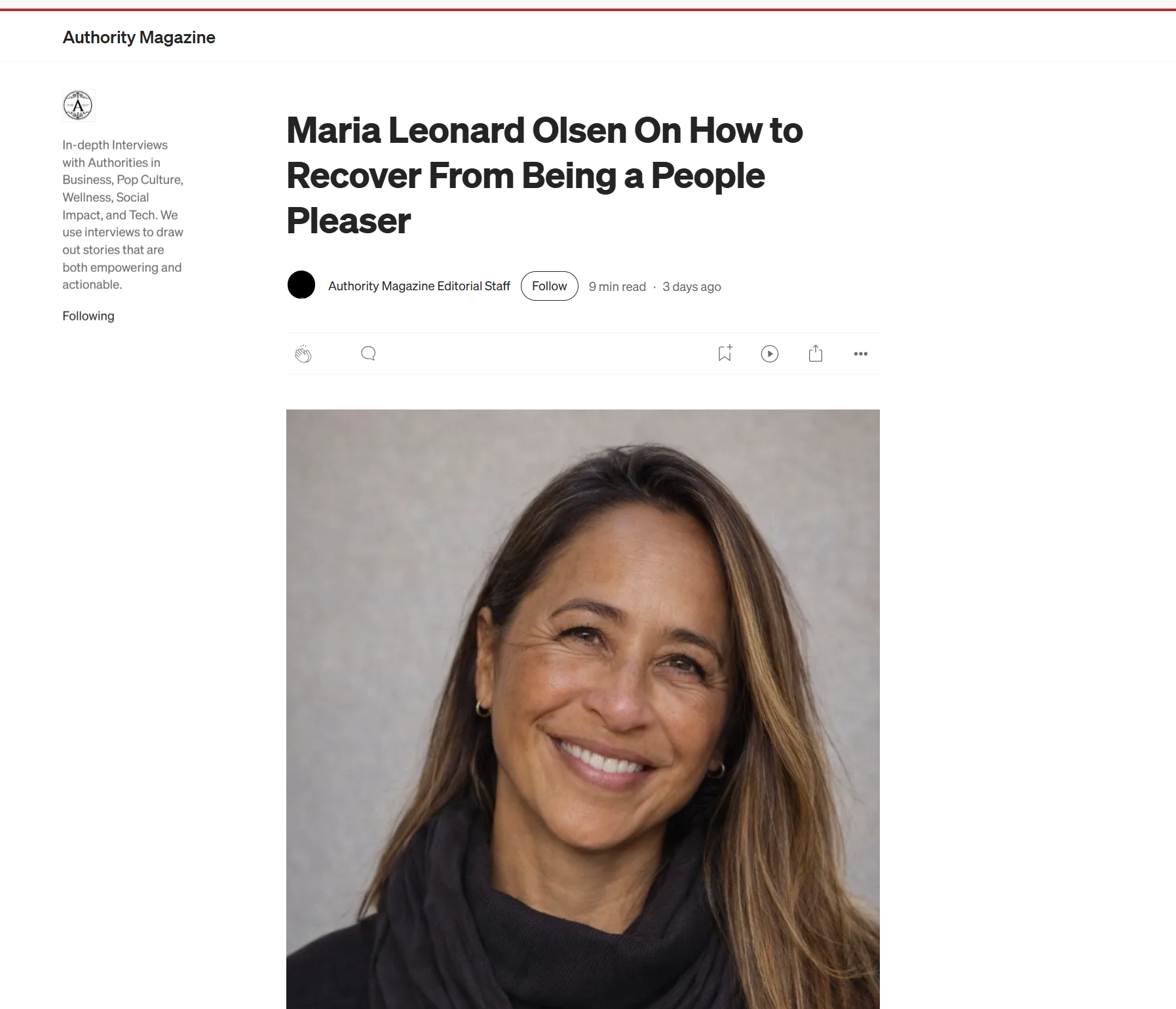
As a part of this series, we had the pleasure of interviewing Maria Leonard Olsen.
Maria Leonard Olsen practices law as a commercial litigator in Washington, DC. She is an Amazon bestselling author (50 After 50: Reframing the Next Chapter of Your Life), podcaster (“Becoming Your Best Version”), journalist, TEDx speaker (“Turning Life’s Challenges into a Force for Good” and “What to Consider Before and After You Take a DNA Test”), book marketing coach for female authors and mentor to women in recovery. Maria served as a political appointee in the Clinton Justice Department and on numerous boards. She writes for several women in midlife publications (including AARP’s The Ethel, The Midst and Kuel Life) and is a frequent public speaker on wellness issues. Her next books will be Before and After the DNA Test: A Practical Guide to Genetic Privacy, Medical Risks and Family Secrets (Bloomsbury 2026) and 60 After 60: Finding Serenity in Your 60s or at Any Age. Learn more at MariaLeonardOlsen.com and follow her on social media @FiftyAfter50.
Thank you so much for your time! I know that you are a very busy person. Our readers would love to “get to know you” a bit better. Can you tell us your “Origin Story”? Can you tell us the story of how you grew up?
I grew up in the suburbs of Washington, DC. My mother was an immigrant to the United States from the Philippines and my father was a white American. It was illegal for them to marry in our home state of Maryland because of anti-miscegenation laws that prohibited interracial marriage in 16 states until 1967. I was raised in a mostly white community and felt like an outsider. Like many children, I desperately wanted to fit in with my classmates and neighbors. It took me many years to appreciate my uniqueness.
My parents divorced when I was young. Because we were Catholic, my parents were excommunicated because of the divorce, which was the church’s practice at the time. This also made me feel othered from my friends.
I did very well academically, which led to professional success. Much of my early life led to people-pleasing behavior that took years to unlearn.
Can you tell us a bit about what you do professionally, and what brought you to this specific career path?
I am an attorney at The Pels Law Firm, a boutique litigation firm in Bethesda, Maryland. I also am a podcaster (Becoming Your Best Version), in which I interview inspiring women each week. I have written several books. My most popular book is 50 After 50: Reframing the Next Chapter of Your Life, which also is the subject of my TEDx Talk, “Turning Life’s Challenges into a Force for Good.”
I became a lawyer to please my immigrant mother. I write and speak to please myself.
Thank you for all that. Let’s now turn to the main focus of our discussion about People Pleasing. To make sure that we are all on the same page, let’s begin with a simple definition. What does “People Pleaser” mean to you?
People-pleasing means doing things primarily to please others, even at the expense of pleasing ourselves. It involves putting other people’s needs before our own. It is an often misguided attempt to get others to like and accept us.
On the surface, it seems like being a person who wants to please others is a good thing. Can you help articulate a few of the challenges that come with being a people pleaser?
Being a people pleaser can cause people to lose themselves. Many people pleasers forget who they are and what they want in life. It can lead to unhealthy co-dependency, basing one’s own happiness on the happiness of others.
Does being a people pleaser give you certain advantages? Can you explain?
As an employee, pleasing one’s superiors is advantageous and can lead to promotions and other monetary rewards. But people-pleasing differs from simply doing a good job. It implies losing one’s sense of self. If a job requires that of you, you should reconsider your employment.
Can you describe a moment in your life when you realized that your own people-pleasing behavior was more harmful than helpful?
When I was in a therapy session with a psychologist, she asked me, “What makes you happy?” At the time, I could think of nothing but my children. She pushed me to dig down deeper and examine what brought me joy. I realized that I had subjugated my needs to those of others in an unhealthy way. I spent years re-discovering myself, separate from anyone else.
In your opinion, what are the common root causes of people-pleasing behavior?
I believe people-pleasing behavior stems from a lack of self-esteem. It can result from experiencing abuse, especially if the abuse occurred during critical developmental periods in one’s life. It can come from socialization. In past generations, children and women were routinely rewarded for people-pleasing behavior. That has been changing, however.
How does people-pleasing behavior impact personal relationships?
If a person lacks self-esteem, personal relationships can become lopsided and damaging. If one person is always trying to please their partner at the expense of their own needs and there is no reciprocity, the relationship is likely doomed or, at least, not enriching.
How does people-pleasing behavior impact professional relationships?
Professional relationships may be negatively impacted, as well. An employee who is stuck in people-pleasing behavior may hold back from making helpful contributions to the organization. They may lack the confidence to share their views and ideas. They may eventually lose the respect of their colleagues and superiors and lose out on opportunities to develop and advance to any leadership positions.
How can long-term people-pleasing behavior impact an individual’s mental health?
People-pleasing can lead to depression and anxiety. It can lead to a diminishment of self-worth. If we devote our lives to pleasing another person and that person rejects us, we can become bereft and lose hope.
We are not on this planet merely to subjugate our needs to those of others. We all have a meaningful contribution to make in this life. We all deserve the opportunity to self-actualize.
In your experience, what is the role of self-awareness in overcoming people-pleasing tendencies, and how can individuals cultivate it?
One way I was able to stop people-pleasing was to ask myself, before committing to anything, whether it was something I really wanted to do, whether it brought me closer to who I want to be, or whether I would simply be saying yes to please another person. If the answer was only to please another, I trained myself to reply that I had another obligation. That obligation may have been just to restoring my energy reserves. It was not necessary to explain the conflicting obligation to the other person. This exercise in self-awareness gave me clarity and, eventually, the confidence to say no.
Here is the primary question of our discussion. Based on your experience or research, what are the “Five Strategies Or Techniques That Can Help Individuals Break Free From The Cycle Of People-Pleasing”? If you can, please share a story or an example for each.
1. Learn how to say no to protect your own energy.
I just shared one technique in the previous answer: Learn how to say no to protect your own energy. Become aware of your people-pleasing behavior by asking yourself why you are doing certain actions. Awareness is the first step to changing behavior. I realized that, at one time in my life, I said yes to almost every invitation. I no longer do that. As a result, my life is much calmer and I have more time to practice self-care.
2. Do things to increase your confidence and self-esteem.
Try new things to expand your comfort zone. Remember that courage is not the absence of fear, but feeling fear and taking action anyway. I tried singing on stage at an open mic night, for example. I am not a good singer and was afraid, but moving through the experience despite the fear made me feel more comfortable on stage in other settings. I do a great deal of public speaking now and this experience helped propel me forward and decreased my nervousness about speaking in front of audiences.
3. Build a supportive tribe.
Surround yourself with people who encourage and uplift you. Avoid negative people as much as possible. I have joined multiple groups of women in midlife, which has helped me develop a group of encouraging friends and gain confidence. You can find groups on Facebook, if you cannot find them in your community. Women’s retreats also helped me find like-minded people and have been very healing.
4. Take inventory of what brings your joy.
Make a list. Take steps to bring more of those things into your life. Develop independent interests so that you are not looking to others for affirmation. Travel has become one of my favorite things to do. Travel expands my perspective and builds my self-confidence. If you do not want to travel alone, there are many travel groups available. Road Scholar is a wonderful travel group.
5. Do not settle for the gray safety that sameness promises.
If you do not like your behavior or how your life is going, do something to change it. You can start small. I keep a running list on my phone of things I want to try and places I want to visit. And then I do them. If you need ideas, check out my book, 50 After 50: Reframing the Next Chapter of Your Life. It’s available on Amazon and at libraries and bookstores. Find a friend to be your accountability partner, to keep you moving forward. Your life is happening right now. It’s up to you what you do with it.
What steps should people pleasers take to establish healthier boundaries?
Develop confidence in yourself. Share your thoughts with a trusted friend. Work with a therapist, if necessary. Consider attending some Al-Anon, Co-Dependents Anonymous or Adult Children of Alcoholics meetings, many of which are available online. Al-Anon was started to support friends and families of alcoholics and addicts, but has expanded to include people in dysfunctional relationships. We all have at least one of those in our lives.
How can someone who is naturally empathetic maintain their compassion while becoming more assertive?
Recognize that compassion is laudable, but apply that compassion to one’s self, as well. Do not ignore your own needs. Stand up for yourself when necessary. Establish appropriate boundaries. Consider using daily affirmations. You can model healthy behavior for others, like your children or colleagues. You are worth it.
What are the most common misconceptions about people pleasers, and how do these misconceptions affect their journey toward recovery?
I suspect that people pleasers are regarded as weak by many people. When someone feels disempowered, they are less likely to try to recover from harmful behavioral patterns.
What role can therapy or counseling play in helping individuals overcome people-pleasing behavior?
Therapy can help people look within and question various situations and relationships in their lives. A therapist can be a valuable sounding board for one’s fears. Sometimes, just sharing fears with a trusted person can diminish the feeling.
If you are worried about your people-pleasing behavior, run it by a therapist. A good therapist can help you work through this issue and develop healthy responses. I am a big fan of Dialectical Behavioral Therapy, which is designed to help people manage intense emotions, improve relationships and reduce self-destructive behaviors.
Life coaches also can help. The life coach industry has exploded because so many people want help to live their best lives. I have interviewed several life coaches on my Becoming Your Best Version podcast and have had a few sessions myself, which helped me clarify my goals.
You are a person of great influence. If you could start a movement that would bring the most amount of good to the most amount of people, what would that be? You never know what your idea can trigger. :-)
It would be a universal kindness movement — kindness to others and to oneself. If everyone in the world were kind, we would have so many fewer problems.
How can our readers further follow your work online?
Check out my website, www.MariaLeonardOlsen.com, and follow me on social media @FiftyAfter50.
Thank you so much for sharing these important insights. We wish you continued success and good health!
https://medium.com/authority-magazine/maria-leonard-olsen-on-how-to-recover-from-being-a-people-pleaser-9cb3ece708ad